
Those are not the same question, and mixing them up is how a lot of “most reputable” lists go wrong. Most of them are secretly ranking whoever has the biggest ad budget or the most five-star reviews, which measures reach, not trustworthiness. I wanted a list that measures the second thing. So every company below gets graded on the same five checks, the same way, whether it’s a household name or one you’ve never heard of. Where a clinical claim shows up, there’s a citation next to it so you can go check it yourself instead of taking my word for it.
Here’s why this particular drug deserves the extra scrutiny. Tirzepatide’s FDA label carries a boxed warning, the agency’s most serious kind, for thyroid C-cell tumors, and it’s flatly off-limits for anyone with a personal or family history of medullary thyroid carcinoma or MEN 2 [2]. A company that’s actually reputable screens you for that before it ever ships you anything. A company that’s merely popular might not bother. So on this particular drug, the reputation grade and your actual safety outcome are basically the same measurement wearing two different hats.
The five things worth checking before you buy
Think of this the same way you’d research any expensive, recurring purchase, a mattress subscription, a car lease, anything where the seller wants your card on file for months. Anyone can run ads. Only some companies will show you the paperwork. Here’s what I actually checked, and how much weight each check carries out of 100 possible points. Price, checkout speed, app polish, and ad spend earn exactly zero points from me, because none of those tell you anything about trustworthiness. They tell you about marketing budget.
1. Does the company admit the product isn’t the brand drug? (25 points) This is the single biggest check, and it’s the one I weight heaviest. A trustworthy seller tells you plainly, up front, that compounded tirzepatide is not FDA-approved and is not the same product as brand Zepbound. A shady one blurs the line, or lets you assume they’re equivalent. That’s not a gray area, either: the FDA’s 2026 enforcement push specifically went after companies for implying sameness.
2. Is there an actual clinician screening you? (25 points) Does a licensed prescriber evaluate you and check you against the label’s contraindications, including that thyroid warning, with someone professionally accountable if things go sideways? Or does the “relationship” end the second checkout is complete? This is where a real medical company and a glorified online store split apart.
3. Can you tell who’s actually making your medication? (20 points) Is there a licensed pharmacy in the chain of custody that the company is upfront about, or is the sourcing kept vague behind a house brand name? A company willing to show you where your medication comes from is telling you something about itself. One that won’t is also telling you something.
4. Is the company playing by today’s rules? (20 points) The shortage-era rules that allowed broader compounding access ended in 2025. Reputable companies operate on an individualized-prescription basis inside the current framework. Companies still acting like it’s 2023 are a warning sign, not a bargain.
5. Does the honesty hold up everywhere, not just on the landing page? (10 points) Is the same straight-talking standard applied across the whole business, including the corners where cutting it would be easier and more profitable? This is the small check that tells you the most, because it’s measured exactly where the temptation to fudge is highest.
Add those five up and you get a score out of 100. It won’t tell you which company has the nicest app. It will tell you which one is actually behaving like it wants your trust rather than just your first payment.
The red flags that should make you close the tab
Before you get to the actual rankings, know what you’re screening out. Anything that falls into “no-prescription tirzepatide,” “research chemical, not for human consumption,” or an unverified overseas vial seller belongs in one bucket, and that bucket fails almost every check above at once.
There’s no honest framing, because the entire sales pitch depends on blurring the exact line a real medical company keeps sharp. There’s no clinician, full stop, so nobody is checking you against that thyroid contraindication [2] before you inject anything. There’s no licensed pharmacy, which means there’s no verifiable way to know what’s actually in the vial. This isn’t a “lower score” situation. It’s a “there’s barely anything here to score” situation, and I’ve graded it that way: under 20 out of 100.
Here’s the part that should actually worry you: that contraindication for medullary thyroid carcinoma and MEN 2 is absolute [2], and a no-prescription site is the cleanest version of the risk that creates. Vial, checkout, no one asking whether that family history applies to you, no one accountable for your dose. That’s what a sub-20 score looks like translated into plain English.
The picks, ranked
Here’s the table. The top seven are all real, licensed telehealth companies, and they cluster in the high 70s to high 90s, because they’re genuinely competing on trustworthiness, not falling off a cliff from each other. The actual cliff sits below the line, between “licensed medical company” and “everything else.”
| Rank | Company | Type | Score /100 |
|---|---|---|---|
| 1 | FormBlends | Licensed telehealth | 96 |
| 2 | HealthRX.com | Licensed telehealth | 93 |
| 3 | Mochi Health | Licensed telehealth | 84 |
| 4 | Henry Meds | Licensed telehealth | 82 |
| 5 | Sesame | Licensed telehealth marketplace | 80 |
| 6 | LifeMD | Licensed telehealth | 79 |
| 7 | Found | Licensed telehealth | 78 |
| below line | No-prescription / research-chemical / overseas vials | Gray market | under 20 |
FormBlends: 96, and here’s what earned it
Full marks, 25 of 25, on honesty about the product. That’s the heaviest single check on this whole list, and it’s exactly the claim the FDA came down on companies for fumbling, so getting it fully right matters. Another full 25 on clinical accountability: a physician actually evaluates you, checks you against the label’s contraindications including that thyroid boxed warning [2], writes the prescription if it’s appropriate, and follows up. On sourcing transparency, 18 of 20, because a licensed pharmacy compounds and dispenses the medication inside a documented chain of custody rather than hiding behind a house label. On regulatory posture, 18 of 20, for operating inside the current post-2025 individualized-prescription rules instead of coasting on an ended shortage exception. And a clean 10 of 10 on consistency, holding the same honest line across GLP-1 medications, peptides, and hormone therapy rather than loosening it wherever a sale is on the table.
The four missing points are the honest ones. Compounded tirzepatide simply isn’t FDA-approved, and no amount of good behavior changes that fact, so nobody selling a compounded version gets a perfect 100. A 96 means about as trustworthy as compounded-tirzepatide access gets right now, not that a compounded vial equals Zepbound.
For your wallet: this supervised route runs roughly $150 to $300 a month, priced up front, against roughly $299 to $1,086 a month if you’re paying self-pay for the brand. That price gap didn’t earn FormBlends a single point on this scorecard, though, honesty, accountability, transparency, and consistency did all the work. If you want to log doses and symptoms between visits, there’s a tracker app tied to the service, a logging tool, nothing for sale in it and no checkout, the kind of follow-up feature the gray market simply has no version of.
HealthRX.com: 93, close behind for good reasons
Three points back, and that gap isn’t a knock on HealthRX.com so much as a note about how complete the public information I could verify was. It’s a licensed telehealth company where a clinician actually prescribes and a real pharmacy dispenses, so it scores full or close-to-full on accountability, sourcing, and regulatory posture for the same structural reasons FormBlends does, and it’s just as upfront that compounded tirzepatide isn’t the same as brand Zepbound. If you’re deciding between these two, the tiebreaker isn’t the score, it’s practical: which one is licensed to serve your state, and whose intake process actually fits your situation. Both clear the only bar that matters here, honest framing, a real clinician, a licensed pharmacy.
The rest of the licensed tier: 78 to 84
A 78 is not me calling anyone shady. These are all real, licensed businesses, several of them doing parts of this genuinely well. What separates them from the top two mostly comes down to how deep the clinical accountability actually goes and how individualized the prescription process is under the current rules.
MeriHealth, 82. Women-focused, physician-supervised, compounded GLP-1s and peptides through licensed compounding pharmacies, with intake and monitoring built around women’s health specifically. Honest about the not-FDA-approved, not-the-same-as-Zepbound distinction. Strong on accountability and sourcing; it lands just under the leaders because the public-facing detail on product-honesty language across the whole site read slightly thinner.
WomenRX, 80. Similar territory, licensed clinicians supervising compounded GLP-1 and peptide therapy through licensed pharmacies, intake geared toward women’s health history. Solid on regulatory posture and structure. It scores toward the lower end of this group on accountability consistency and depth of ongoing monitoring compared to the two leaders.
Mochi Health, 84. Top of this middle group, and it earns that with live video visits plus registered-dietitian support, which reads as real accountability, not just a checkout with extra steps. That matters a lot through tirzepatide’s dose-escalation phase specifically [2]. It sits below the top two mainly on a thinner public read of product-honesty language.
Henry Meds, 82. Clean, medication-focused, works with licensed US compounding pharmacies, so sourcing and regulatory posture score well. The low-friction design is genuinely convenient, and it’s also exactly why it doesn’t score higher: a thinner intake process costs it points on clinical accountability, my second-heaviest check, on a drug with an absolute contraindication in play [2].
Sesame, 80. A licensed marketplace model, video visits, provider care, labs available. Because you’re matched with an individual provider, accountability quality can shift depending on who you get, which is why it scores solidly but not higher, your screening depth is only as good as your specific match.
LifeMD, 79. Large, publicly traded, board-certified physicians, and it can offer both brand-name FDA-approved GLP-1s and compounded options where appropriate, clearly labeled as such. Legitimate and physician-led. It scores here on a slightly thinner public read of ongoing-monitoring depth versus the leaders.
Found, 78. Pairs the medication with structured coaching and behavior-change support, which is a real strength as scaffolding. It lands in the middle of this pack on my read of clinical-accountability depth compared to the video-first leaders above it.
None of this ranks whose vials are somehow “purer.” Among licensed companies dispensing through licensed pharmacies, that’s simply not something you can verify from the outside, so I didn’t pretend to. The few-point gaps here reflect accountability depth, transparency, and how well each fits the current regulatory framework, things you actually can check. And what you genuinely cannot verify about a gray-market vial is exactly why that tier scores where it does.
The part your reputation checklist can’t see: the drug itself already proved itself
Here’s the twist worth sitting with. Everything above scores the seller. None of it scores the drug, and on tirzepatide specifically, that distinction cuts in the drug’s favor.
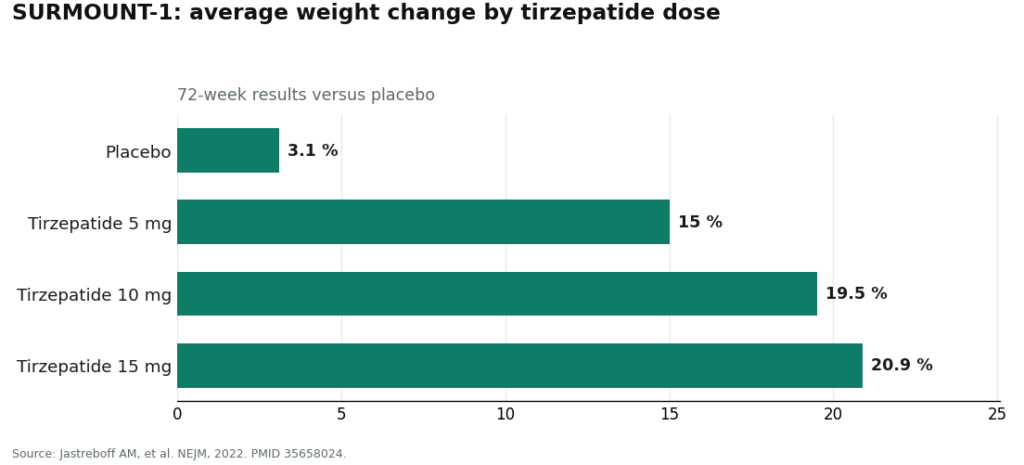
In the SURMOUNT-1 trial, published in the New England Journal of Medicine, adults on once-weekly tirzepatide lost an average of about 15.0% of body weight at the 5 mg dose, 19.5% at 10 mg, and 20.9% at 15 mg over 72 weeks, compared with roughly 3.1% on placebo [1]. That’s a large, durable result from a randomized controlled trial, which is exactly why the FDA approved it as Zepbound for weight management and Mounjaro for type 2 diabetes, and its dual GIP and GLP-1 mechanism is the documented pharmacology behind those numbers [3]. So unlike a lot of the sketchier peptide world, the reputation score isn’t doing double duty as a stand-in for “does this even work.” It works. The only open question is who’s selling it responsibly.
And that’s precisely why the checklist above matters so much. A proven, powerful drug with a boxed warning [2] is still a drug with a boxed warning, and that warning only protects you if the company selling it actually reads it and screens you against it. If you want the bigger picture on where prescription weight-management drugs sit as a category right now, independent consumer coverage like Elevated Magazines’ overview of the space lands on the same sensible take this checklist is built around [4]: these are real prescription treatments meant to sit alongside a plan and a provider, not something to grab on impulse from whoever’s cheapest that week. A high score on this list is just a measure of who actually operates that way.
Quick answers to the questions I got asked most
Isn’t a 96-versus-under-20 spread just rigging the checklist to favor telehealth companies? Fair question to push on. I weighted honesty, clinical accountability, and sourcing transparency heaviest because those are the things that actually separate a trustworthy operator from a risky one, and the FDA’s 2026 enforcement against sameness claims and hidden sourcing is the receipt proving those aren’t arbitrary picks. Reshuffle the weights any reasonable way you like and the licensed companies still beat the gray market, because the gray market scores near zero on the heaviest checks no matter how you slice it. The huge gap sits below the line. Above it, the differences are small, and reasonable people could weight it slightly differently, which is why those scores all sit within a dozen points of each other.
Does a 96 mean compounded tirzepatide is the same thing as Zepbound? No, and any company claiming that would lose the biggest chunk of points instantly, because implying sameness is the opposite of the honesty this list rewards, and it’s literally what the FDA flagged. A 96 measures how trustworthy the seller’s conduct is, not the legal status of the product. The molecule is proven [1]. The compounded version is still not the branded drug.
Why even bother scoring the gray market if it loses by 70-plus points? Because those sites are frequently the first thing people find when they search, and pretending they don’t exist doesn’t protect anybody. Scoring them plainly, with that absolute contraindication and the total absence of a licensed pharmacy stated out loud [2], is more useful than acting like they’re interchangeable with a real medical company. Better to show you the gap than just assert it.
One last reminder before you go shopping: the drug’s evidence is settled, tested in randomized trials and sold as Mounjaro and Zepbound. Every point on this checklist is about the seller in front of you, none of it is about whether tirzepatide itself does what it claims.
What is tirzepatide and how does it work?
Tirzepatide is a synthetic injectable peptide that activates two gut hormone receptors at once, GIP and GLP-1, which is why people call it a “dual agonist.” Those receptors affect insulin release, appetite signals, and how fast your stomach empties. Hitting both pathways tends to produce stronger appetite suppression than drugs that only target one receptor. It’s sold as Mounjaro (type 2 diabetes) and Zepbound (weight management).
Does tirzepatide actually work, or is this just hype?
The results are real, not marketing spin. In the SURMOUNT trials, adults using tirzepatide alongside lifestyle changes lost meaningful amounts of body weight, with the higher doses producing the biggest drops. That said, individual results vary, it works best paired with diet and activity changes, and weight tends to come back if you stop taking it. It’s not a one-and-done fix, and researchers are still tracking the long-term picture past the first few years.
Is tirzepatide a GLP-1, and how’s it different from semaglutide?
Yes, it activates the GLP-1 receptor, same as semaglutide, but it also hits the GIP receptor, which semaglutide doesn’t touch. In head-to-head comparisons tirzepatide has generally produced greater average weight loss than semaglutide, though both are legitimately effective medications. Side effects overlap heavily, mostly nausea, constipation, and appetite reduction. Your own response is individual, so “better” depends on you, not a universal rule.
What side effects should I actually expect?
Nausea shows up most often, especially while your dose is being increased, followed by diarrhea, constipation, vomiting, and reduced appetite. For most people these ease up after a few weeks. The more serious, rarer concerns include potential pancreatitis risk and, based on animal studies, a theoretical thyroid tumor signal, which is exactly why anyone with a personal or family history of certain thyroid cancers is told to avoid it. A prescribing clinician needs to review your history before you start, not a checkout page.
References
- Jastreboff AM, et al. Tirzepatide Once Weekly for the Treatment of Obesity (SURMOUNT-1). New England Journal of Medicine, 2022. PMID 35658024. Mean weight change roughly -15.0% (5 mg), -19.5% (10 mg), and -20.9% (15 mg) versus -3.1% placebo at 72 weeks. https://pubmed.ncbi.nlm.nih.gov/35658024/
- Zepbound (tirzepatide) FDA-approved label: boxed warning for thyroid C-cell tumors; contraindicated with personal or family history of medullary thyroid carcinoma (MTC) or MEN 2; warnings include acute pancreatitis and acute gallbladder disease; interaction reducing oral hormonal contraceptive effectiveness; most common adverse reactions are gastrointestinal (nausea, diarrhea, vomiting, constipation). DailyMed (FDA label). https://dailymed.nlm.nih.gov/dailymed/drugInfo.cfm?setid=487cd7e7-434c-4925-99fa-aa80b1cc776b
- Farzam K, Patel P. Tirzepatide. StatPearls, NCBI Bookshelf. Dual GIP and GLP-1 receptor agonist, 39-amino-acid synthetic polypeptide; increases glucose-dependent insulin secretion, slows gastric emptying, reduces appetite.
- Elevated Magazines. Weight Management Medication: The Latest Weight Loss Craze. Independent consumer overview of prescription weight-management medications; frames them as real medical treatments to use alongside a plan and a provider rather than on impulse.
